the water tower is on a hill at the back of a reserve behind our house. it's pretty much completely made of concrete but i took a contact mic to see what i could find.
pipe
a series of pipes run around the perimetre of the tower. i chose one and began tapping it - it has amazing overtones and a long sustain. the pipe itself doesn't make any sound, it's only when it's activated you get to hear the sounds travelling through it.
the first sound is from me scraping the outside of the pipe with my hands.
further around the water tower was the main stairwell to the top. at the base of the stair structure was a metal guard with a steel box mounted on it housing a padlock.
i had a lot of fun with this structure, running the back of a cello bow over it.
i was also able to pull a metal sheet around the casing which reverberated through it. this recording is complete with text message (DM tweet) from my partner Hinemoana in the wild west of wyoming.
ok...so i'm using a title here which references steve roden's airform archives (one of my favourite sites).
today i decided to continue with the original heater recording - to explore the recording further as visual artists do with sketches - different angles, colours, materials.
which lead me to thinking about graphic score, in particular the meshing of what we see with what we hear. this was fuelled in part by the photographic scores of jez riley french and the recent writings of steve roden, particularly his post when sounds become drawings
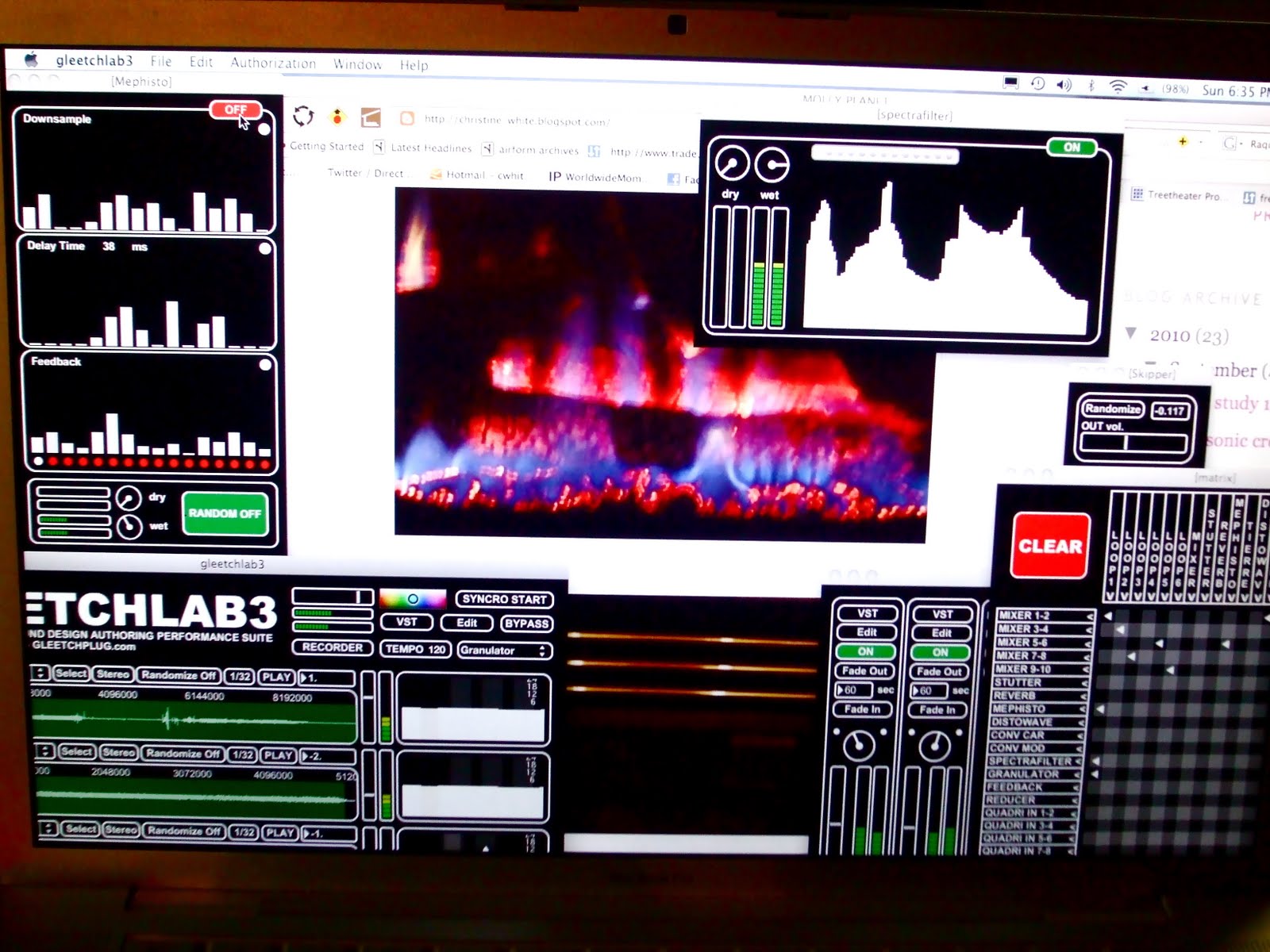
i have been wanting to familiarise myself a bit more with the gleetchlab programme i have. gleetchlab allows realtime processing of sound. i decided to have a play with some of the DSPs available in gleetchlab and started with spectrfilter.
spectrafilter is a 128 band eq. using the flame photo as a graphic score, i manipulated the spectra by attempting to simulate graphically the shape of the flames in the photo. the result was as follows:
next i decided to play with the mephisto which is described as a 'step sequenced delay with down sample'. once again i chose the parameters based on a visual comparison with the flame photo.
i was on a fun roll by now so next i loaded another heater recording and eq'd it again according to the graphic. this time i was able to have two heater recordings with flat eq and one with flame-eq - this replicated the flame and the gold bars of the heater.
ok so i needed three gold bars on top and two on the bottom...i was having too much fun to check!
i added two more affects for fun - one was a reversing of this particular heater recording, and the other was a stutter affect. the stutter affect may have been overused - it had no direct graphical reference to the 'score' it was my intuitive addition and i told myself it reminded me of the crackings of a natural fire.
what remained was to choose what parameters were used when - and this was largely intuitive at this stage as i was getting my head around using the application. so here is a demo excerpt and the final screenshots. listening back now it prob needs some smoothing out on the ears - mixing not being my strong point...but it is a starting place for me in exploring place and sound and integrating them somehow.
having now moved from a bach-style cottage-on-a-hill to a modernised bungalow on the flat, i am beginning a series of sound studies for our new home...and it begins with the gas heater.
i actually became aware of some beautiful heater drones the day after World Listening Day (18 July 2010). my partner hinemoana's new poetry book 'koiwi koiwi' was launched on World Listening Day - it has some pretty amazing sound imagery coincidentally. you can find out more about it here.
anyways, i got pretty crook that night (not self inflicted no) and so the next morning was partially spent lying on the floor in the lounge recovering. in rest and stillness we can often hear sounds we otherwise wouldn't, and it was in this state that the heater came alive for me. it possibly was made all the more present because my head was resting on the wooden floor and so the drones of the heater travelled from the floor and in through the bones of my head.
on that particular day it was very calming.
so, with homemade contact mic in tow, i have now recorded the heater. my flatmate marian commented that it sounds like a whole haunted house is residing in there...we could hear metallic booms and banging that aren't always obvious in the living room or that otherwise sound like small creaks. i also particularly love the overtones when the fan is on.
i have added some eq to try and minimise the static sounds and tones which seem to be part and parcel of the homemade contact mic set-up i use.
some sounds are of me lifting the cover to turn on/off the fan or to turn the heater up. it's a right playground.
sonic creatures emerged from the subliminal minds and object-play of a group of volunteers (mainly guitar students). each person was asked to choose three objects that appealed to them for any particular reason. they were then to create sound combinations from these objects, which were recorded (and in some cases manipulated) to reveal a sonic creature. immediately after the object-play and before the final creature sound was revealed to them, the participants were asked to name and describe the creature.
these recordings are some more of the results...
Guotog
Pinikusball musicato
Sonico
Skefotappin
Blubba Bubba
for notes re: the development of the sonic creature idea read here
finally a stretch of time for some sound-making but what it was to be i didn't know....turned out to be another sketch-song. seems to be a bit of a project of mine - to create short songs as improvisationally as i can - as few recording takes as possible. the idea is to come up with something and to record without working out structure or nailing down the part.
this song ended up being just under two minutes long with three guitar parts and three vocals.
i am still sometimes a bit at odds with myself as to why i do these sketches. am i not brave enough or disciplined enough or clever enough to develop a 'piece of substance' ever again? at times i feel torn between music-making, song-writing and, now, sonic art or sound-making...so much to do so little time. if left to their own devices, these pulling thoughts can create havoc with the self esteem.
but there are other reasons to do these sketch-songs that are more about running towards than running away from something. they bring out a type of play which allows for synchronicities and for the working of subconscious which, i guess is what i need when feeling back at the beginnings of making.
whilst out one day catching up with myself and wandering through the tributaries of the internet, i happened upon Ross Bolleter and his ruined pianos. Marvellous!
I discovered Ross and the ruined pianos from the video post below (thanks to Everyday Listening):
the excerpt about Ross occurs at 3'30". once again it caught my eye because of the interplay between sound, music-making and site - the 'landscape' of the music-making object and its subjectiveness to time and environment. how this music-making is truly linked to the physical context it appears in - the extent and possibilities provided by nature's tunings and the responsiveness of the improviser to this. unique music-making from unique materials.
Each Ruined Piano is utterly unique with respect to action and tuning (if we can talk of tuning at all). An F# one and a half octaves above middle C on a West Australian Ruined Piano in a semi-desert environment differs radically from the same note on a flooded piano in a studio four floors below pavement level in Prague.
A Ruined Piano has its frame and cabinet more or less intact, (even though the soundboard is cracked wide open, with the blue sky shining through) so that it can be played in the ordinary way. By contrast, a Devastated Piano is usually played in a crouched or lying position.
A piano judiciously left in the open and exposed to all weathers will ruin. All that fine nineteenth-century European craftmanship, all the damp and unrequited loves of Schumann, Brahms and Chopin dry out, degrading to a heap of rotten wood and rusting wire. The piano returns to aboriginality, goes back to the earth where the chirrup of its loose wires blown about by the desert Easterly is almost indistinguishable from the cicadas’ long electric blurt.
However, it’s not necessary (or desirable) to burn, drown or bury a piano in order to ruin it. A Ruined Piano should ideally be an object trouvé – and be played as found.
ROSS BOLLETER from The Well Weathered Piano (WARPS Publications, 2005) as cited on Modisti
an excerpt from the album is found on the above link - i am getting this album! beautiful sounds.
well, it has been such an incredibly long time since i have appeared here - it was getting more difficult to do so - but here i am - if only to say hi and start again.
i moved house about a month ago which took me out of routine for a few weeks, but for some reason, this feeling of displacement, busyness-with-nothing-really-to-show-for-it, a feeling of over-emphasis on house/domestic/practical matters etc etc has just continued to elongate! i finally need to stomp it on the head and try and find some semblance of interest in the things i were interested in and involved with - if only to regain sanity!
and - so it seems - combining strange sounds and making little non-consequential movies still seems to reign. the movie below was the culmination of an improvised sound-play session combined with an attempt at small movie-making which combines my love of origami with my budget/material capabilities. hopefully this play and more like it will give formation to a larger piece - but for now this is it.
 the water tower is on a hill at the back of a reserve behind our house. it's pretty much completely made of concrete but i took a contact mic to see what i could find.


 i had a lot of fun with this structure, running the back of a cello bow over it.